Bringing Geometry to Life: The Creative Power of Printable Patterned Cube Templates
For many, the world of mathematics, particularly geometry, can feel abstract and distant. Terms like volume, surface area, and 3D shapes are often confined to textbook diagrams and formulas on a page. But there exists a wonderful bridge between these concepts and tangible understanding: the simple, humble cube. With the advent of accessible, printable patterned cube templates, this fundamental geometric shape transforms from a theoretical idea into a hands-on, creative tool. These templates are not just paper crafts; they are practical exercises designed to make maths creative, demystifying core principles and bringing palpable fun into learning.
What Are Printable Patterned Cube Templates?
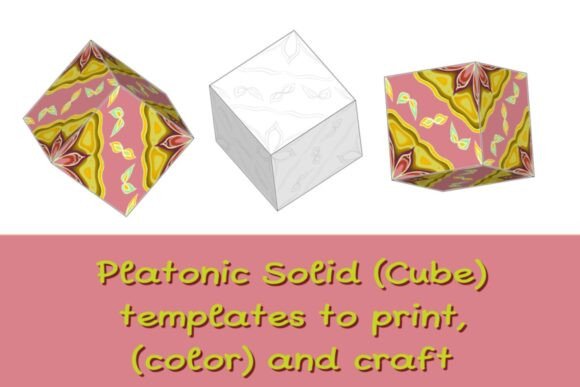
At their core, these templates are pre-designed paper layouts that allow anyone to construct a perfect cube. Typically provided as PDF files for easy printing, they present the cube's six faces in a flattened, net-like arrangement. The key innovation lies in the pattern. Instead of plain white squares, these faces are adorned with a continuous, seamless design. This transforms the cube from a bland geometric model into an attractive art object. A common offering includes two versatile templates: one with a grey and white pattern that invites personalization through coloring, and another already vibrantly colored, ready for immediate crafting. This duality caters to both creative expression and convenience.
The Dual-Template Approach: Creativity and Convenience
- The Customizable Template (Grey & White): This version features a seamless pattern printed in monochrome. It serves as a blank canvas for artistic exploration. Users can color the pattern with pencils, markers, or paints, personalizing their geometric creation. This process engages the maker in a deeper observation of the shape's structure, as they color across the folds and faces.
- The Ready-to-Craft Template (Pre-Colored): This template is immediately vibrant and visually complete. It is optimized for printing and designed for those who wish to jump straight into the construction phase. It offers instant gratification and a beautiful final product, perfect for classroom activities or quick creative projects.
Both templates, usually bundled together in a convenient zip file, are engineered for successful crafting. They include precise cut lines and fold marks, guiding the user through the transformation from a 2D sheet of paper to a 3D Platonic solid.
The Purpose and Significance: Making Abstract Concepts Concrete
The primary purpose of these templates is educational empowerment. They tackle the common challenge of visualizing three-dimensional space and properties. When a student reads about "surface area," it can remain a numerical exercise. But when they cut out a patterned cube net, they are literally handling the area that will become the cube's surface. Calculating the area of one face and multiplying by six becomes a formula verified by physical experience.
Similarly, volume—the space inside the shape—gains context. Holding the completed cube in your hand, you are holding its volume. The template makes the abstract, concrete. This hands-on approach is foundational to understanding more complex geometry and spatial reasoning. Furthermore, the cube is the most basic of the five Platonic solids (perfectly regular, polyhedral shapes), making it an ideal starting point for exploring this fascinating area of mathematics.
Clarifying a Common Assumption
A common misunderstanding is that such tools are only for young children. While immensely effective in primary education, their relevance extends far beyond. Adults re-learning maths, artists exploring form, designers prototyping, or even therapists using spatial tasks can benefit. The act of crafting is a universal learning and mindfulness activity. The patterned cube template elevates this craft from a simple paper box to a focused geometric exploration, suitable for all ages seeking a tangible connection to mathematical ideas.
Practical Relevance in Modern Life and Education
In today's educational landscape, which increasingly values STEAM (Science, Technology, Engineering, Art, and Mathematics) approaches, these templates are a perfect fusion. They inject Art directly into Maths. The seamless pattern isn't merely decorative; it provides a visual continuity that challenges the maker to align designs across edges, reinforcing the concept of adjacency in 3D shapes. This is maths made creative.
In the classroom or homeschool environment, these printable resources offer an affordable, reusable, and engaging activity. Teachers can use the customizable template for a cross-disciplinary lesson combining geometry with art theory (color, pattern). The pre-colored template can serve as a quick, rewarding group project to solidify understanding after a lesson on cubic shapes. The resulting cubes can become physical manipulatives for further exploration—comparisons with other solids, discussions on symmetry, or even playful dice for probability games.
Beyond the Classroom: Creativity, Technology, and Daily Life
The application stretches into daily creative practice and modern technology. For crafters and hobbyists, these patterned cubes become beautiful ornaments, gift box prototypes, or elements in larger paper sculpture. The process of cutting, folding, and assembling is a meditative, skill-building exercise in precision and patience.
In a technological context, this hands-on understanding of basic 3D shapes is a subtle but valuable foundation for digital skills. Understanding the properties of a cube aids in visualizing 3D modelling, computer graphics, and even understanding architectural forms. The printable template is a low-tech analogue to digital design, building spatial intelligence that is transferable to software environments.
Building a Broader Understanding of Geometry Through the Cube
Starting with the cube is the first step in a wider geometric journey. Once one comprehends the cube's properties through physical creation, other concepts become more accessible.
- Scaling and Proportion: By printing the template at different sizes, one can create cubes of various volumes, directly observing how changing the face area affects the overall size. This is a practical lesson in scaling.
- Comparison with Other Solids: A crafted cube can be held alongside a pyramid or a prism (which can also be made from printable nets), allowing for direct comparison of faces, edges, vertices, and stability.
- Real-World Connections: The cube is everywhere: sugar cubes, building blocks, storage containers, dice. The template activity builds an awareness of this geometric form in our surroundings, fostering a more observant and analytically minded perspective.
The patterned aspect specifically teaches about surface continuity and design in three dimensions. How does a pattern wrap around a shape? This is a key principle in product design, textile design (for wrapping boxes), and packaging.
A Step-by-Step Guide to Creative Mathematical Exploration
Using the printable patterned cube templates is a straightforward process that yields profound understanding.
- Step 1: Acquisition and Preparation. Download the provided zip file containing the two PDFs. Select your template based on your goal—creative coloring or immediate crafting. Print the PDF, ideally on slightly thicker paper like cardstock for a durable result.
- Step 2: Engagement with the 2D Net. Before any cutting, observe the layout. Identify the six square faces. Trace the seamless pattern across them. For the grey-white template, this is the time for coloring—a careful study of the shape's layout.
- Step 3: Cutting and Folding. Precisely cut along the outer solid lines. Then, fold along the dashed or dotted fold lines. This is where the 2D becomes 3D. Each fold creates an edge of the future cube.
- Step 4: Assembly. Apply glue or tape to the designated tabs and join the faces together. As you assemble, watch the pattern come together and the geometric shape emerge from your hands.
- Step 5: Reflection and Exploration. Once crafted, hold your cube. Count its faces (6), edges (12), and vertices (8). Estimate its volume by comparing it to known objects. Discuss its surface area by imagining unfolding it back to the net. This reflective step solidifies the learning.
The Final Fold: A Tool for Lifelong Learning and Fun
Printable patterned cube templates are more than just a craft project. They represent a powerful pedagogical tool and a delightful creative outlet. They answer the call for practical exercises to make maths creative, ensuring that volume, surface area, 3D shapes, Platonic solids, and geometry are no longer abstract concepts. They become experiences—something you can build, color, hold, and understand. Whether used in a formal educational setting, as a family activity, or a personal creative pursuit, these templates build a foundational spatial awareness that benefits mathematical thinking, artistic expression, and everyday problem-solving. By bridging the gap between the abstract and the tangible, they truly bring fun—and deep understanding—into maths.